And that's when the anticipation begins. The expanse of the clear blue skies begins to get interrupted with puffy clouds and in the distance one can see the mountains. The meticulously arrayed almond trees slowly get replaced by rolling hills and the long straight stretches of roads, book ended by curves, become shorter and soon quite torturous.
Yosemite beckons.
The winter has been kind, and the California hills are not as golden as usual. The Live Oaks are green and plentiful, dotting the landscape which is clinging to the last of the winter rain. And in testimony to the atmospheric rivers of the past two seasons San Pedro Lake is full to the brim, a thankful sight for sore Californian eyes.
I have chosen to go on route 120 which is decidedly more picturesque than the other options. After Chinese Camp and just before Moccasin there is a road that veers off to the right — Old Priest Road — it's a secret that only the locals know but it shaves 20 minutes off the drive. Even though the views are beautiful, the steepness of this road and its sharp switchbacks do not permit one to enjoy them.
At the top of the hill is Old Priest Café, a place that I must visit someday but right now Groveland beckons. The next stretch of 120 climbs to a height of 6,500 feet and the May snow does not disappoint. Wet and heavy, it has mostly melted off the roads but still adorns the conifers. As the sun gets warmer, the snow slips off the laden branches and showers the road in a second coming of this late spring gift.
Now Yosemite is within reach. Highway 120 meanders down to the valley floor and before long I am driving by the banks of the Merced river surrounded by Ansel's dogwoods and engulfed by the sounds of the raging Merced.
Fern Spring, Cathedral falls, Sentinel bridge — all familiar stops as I make my way to my favourite place in Yosemite, Cook's Meadow. I just love the calm of it, with Half Dome majestically towering above and this magnificent oak quietly scribing the history of this amazing place.
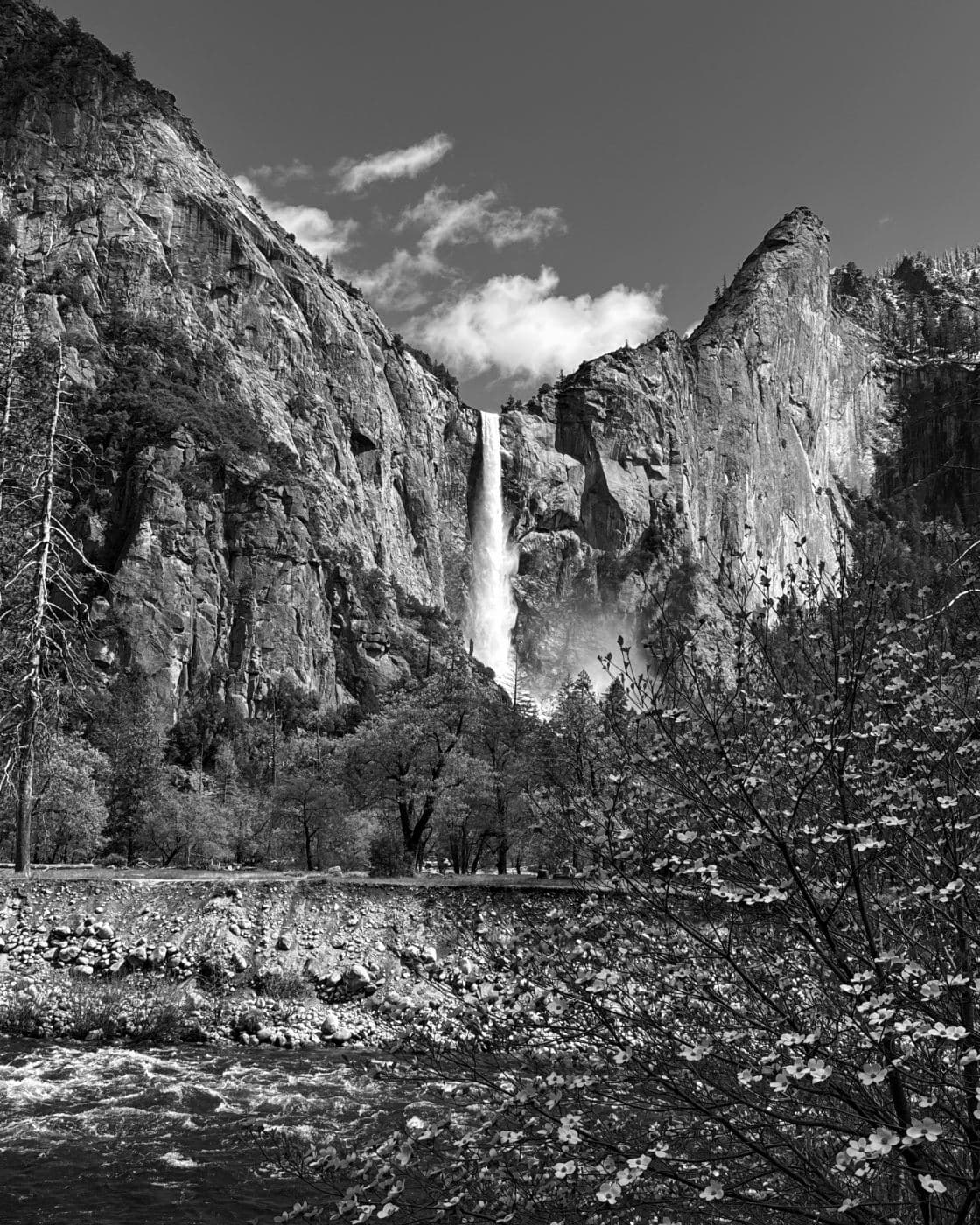
After a quick pilgrimage to all the salient views I settle to photograph Cathedral falls. Armed with a 4×5 large format camera with its tilt/shift capability, I am hoping for success. There is a rare yellow dogwood in full bloom in front of me and behind it, across the river, the torrential falls.
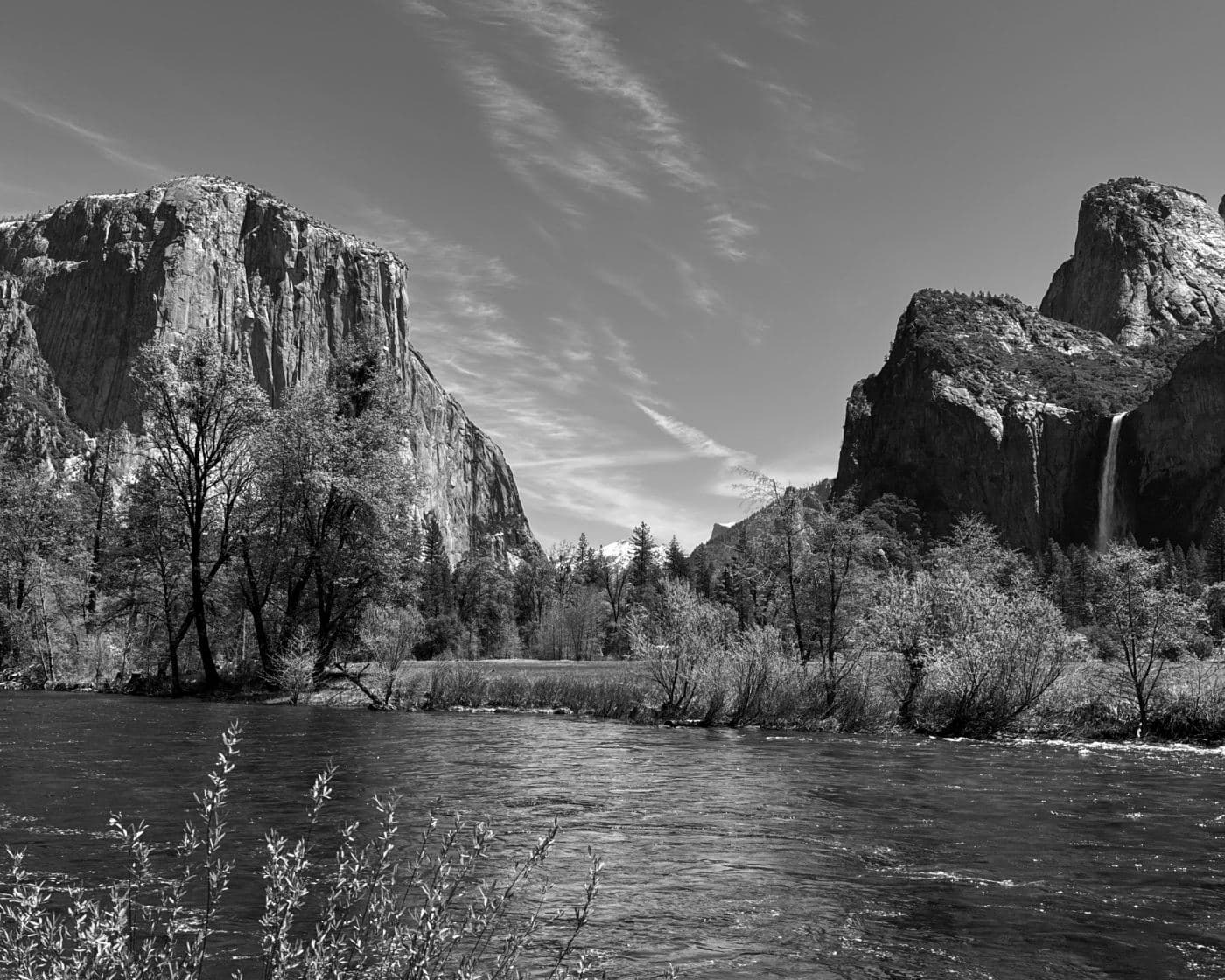
Just around the corner is Valley View — El Capitan on the left, Cathedral falls on the right. El Capitan is quite arguably the most famous sheer surface ever climbed by man. There is a small picnic spot called Cathedral beach, right at its base, and there is nothing like standing there to feel insignificant.
Way back when Yosemite was the playground of the wealthy, the finale of the summer evenings would be to throw the burning embers of a bonfire over the edge from Glacier Point to the amusement of the patronage. Thankfully no more.
In 1973 Galen Rowell had the good fortune to see the sun setting on the ephemeral Horsetail waterfall. This happens only for a couple of weeks in February when the melting snow and the angle of the setting sun are in harmony for a measly 15 minutes — leaving the crowds hushed and in awe. This became the new Firefall.
The "Firefall" pizza, however, can be enjoyed all season long at Curry Village.
May 7th is a new moon. The valley would be truly dark — the kind of dark that makes the Milky Way feel close enough to reach.
What I hadn't fully reckoned with is the valley itself. Yosemite runs east-west, and the galactic center, still low on the horizon in May, needs a clear southern view. The granite walls are magnificent companions, but they are not generous with the sky.
I gave it the college try. With the Leica and a tripod and a great deal of patience, I waited. What I got was Half Dome holding still while the universe wheeled slowly overhead. Not quite the shot I'd imagined. Almost better.
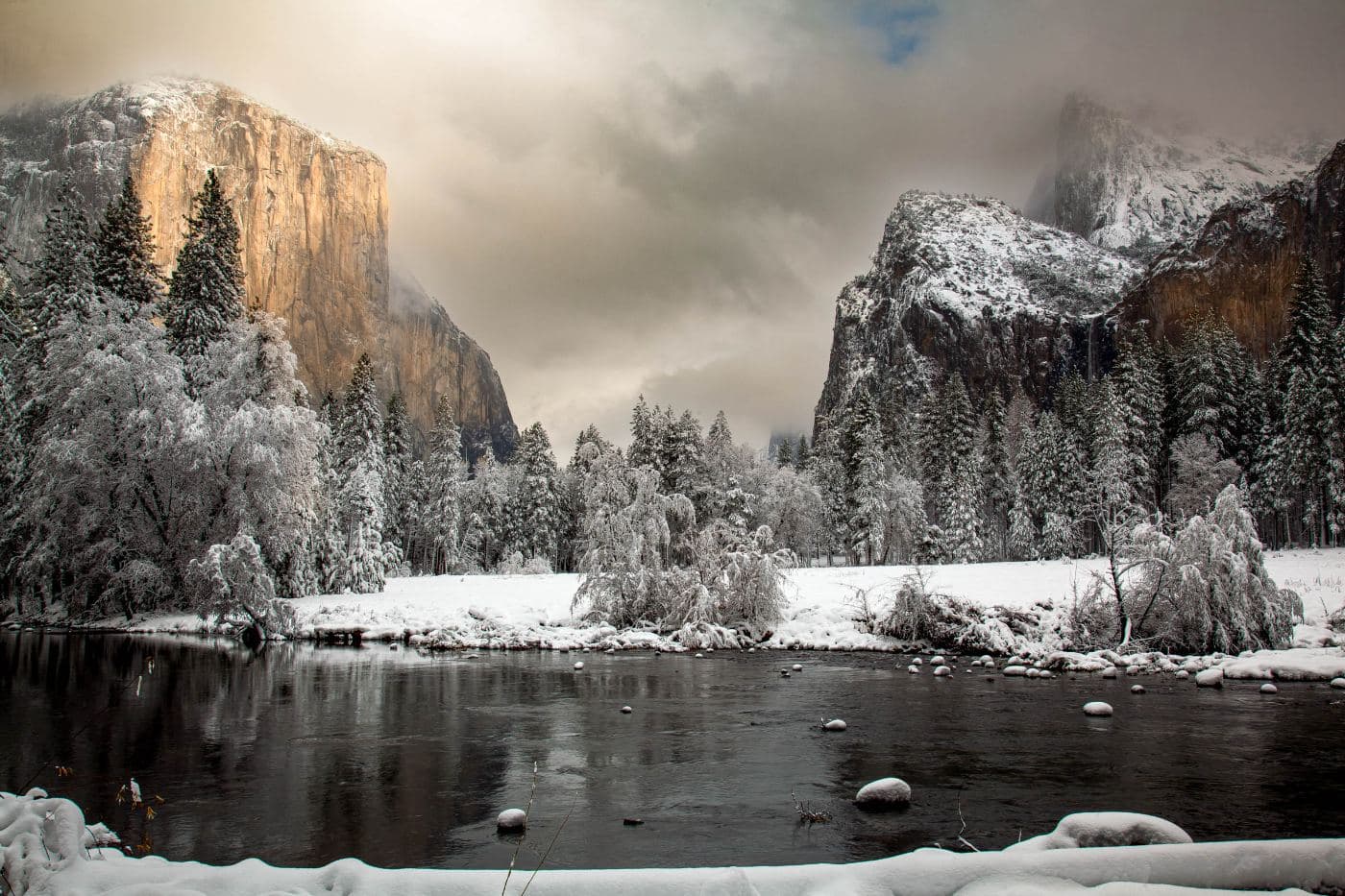
You went to Yosemite again? Yes I did. These pictures of the valley have been taken over 16 years. January, February, May, June, and November. The last two were taken 14 years apart to the day. It all started on a trip in 2009 with the guys.
There is no place like this on earth, and no "possession" that should be dearer to all Americans.